FOR DOCTORS TRANSITIONING TO CONSULTANCY
“Residency teaches you how to practise medicine.
It does not teach you how to survive consultant life.”
The rulebook disappears.
No one tells you that.
The Next Step is the guide to the hidden curriculum of consultant life — the professional and identity shifts that residency never prepares you for.
THE TRANSITION NO ONE MAPS
Why Most New Consultants Quietly Struggle
"You're technically ready. And yet something quietly shifts — in ways you can't quite explain to anyone."
Becoming a consultant is supposed to feel like arrival. And in many ways, it does — for about the first two weeks.
Then the disorientation sets in. Not clinical. You're more than competent. This is something else:
The weight of decisions with no supervision.
The politics of a department you now lead, but were never trained to navigate.
The quiet erosion of confidence in a role you've spent a decade working toward.
Clinical training prepared you for medicine.
It rarely prepares you for power, influence, and leadership inside organisations.
The skills are different. The rules are different.
WHAT BECOMES POSSIBLE?
The Next Step doesn't promise you a perfect consultant career.
It gives you the orientation tools to build one — deliberately, not accidentally.
The Next Step ensures you thrive by making the hidden curriculum visible.
You interview differently- as a future consultant, not a senior trainee
The questions are the same. The level of answer expected is entirely different. You'll know the difference, and you'll be able to demonstrate it.
You lead without losing yourself
Boundaries, workload, emotional containment, and the confidence to make decisions — without the self-doubt spiral that the first year quietly creates in most people.
Most consultants spend year one in reactive mode. You'll enter with a framework. That gap compounds over the rest of your career.
Your first year becomes an asset, not a casualty
You understand the system you're now inside
Job planning, power mapping, discretionary points, peer selection — you learn how the architecture of consultant life actually works, not how it's presented at interview.
You navigate the unsaid things
Credibility gaps. Bias in departments. Differential experience based on who you are, not just what you know. Tools for navigating it — clearly, strategically, without burning bridges.
The transition from trainee to consultant is also a psychological one. You'll have language for what you're experiencing — and tools to move through it, not around it.
You stop waiting for permission to lead
Inside The Next Step you’ll learn how to:
Think like a consultant
Shift from individual patient focus to systems-level thinkingPrepare for the interview and beyond
Learn successful job-hunting and interview frameworks that help you get and settle into the jobInterpret your job plan strategically
Understand how programmed activities shape your time, influence, and long-term workload.Recognise organisational power dynamics
Identify who holds influence — formally and informally — in your department.Navigate appraisal and early career signalling
Understand how reputation and progression actually develop in the first years.
Enrol in The Next Step »»
"This is not a productivity course or a leadership checklist. It's an honest map of the territory residency never shows you."
IS THIS FOR YOU?
Three doctors.
One transition.
The Next Step was built for doctors at a specific career inflection point. See which of these describes where you are right now
SENIOR RESIDENT
You're preparing for the consultant interview — and something feels off about how you're doing it
—————————————————
You're interviewing like an excellent trainee. The panel wants a future consultant. You can feel the gap but can't name it yet.
Interview techniques built for the wrong level
Uncertain how to demonstrate strategic thinking
Wants the inside view before the panel date
SPECIALTY GRADE / SAS DOCTOR
You carry consultant-level responsibility — without the title, pay, or recognition.
———————————
You know more than most about how this works. But the pathway to consultant feels unclear, and the hidden curriculum feels even more hidden from where you stand.
Navigating a system that wasn't designed around you
Unclear how to leverage existing experience strategically
Credibility and visibility gaps that feel structural
NEW CONSULTANT/ EARLY CAREER ATTENDING
You got the job. Now you're in it — and it's not quite what you expected
——————————-
The first year is harder to name than it is to survive. Something has shifted and you need the language, the framework, and the honest conversation about what this transition actually requires.
Imposter syndrome with a new title
Job plan landed and no one explained the implications
Leading while still finding your footing
You're looking for generic time management advice, a leadership motivation course, or a shortcut to the interview without doing the deeper work. This course is substantive and rewarding. It will ask things of you.
THIS IS NOT FOR YOU IF
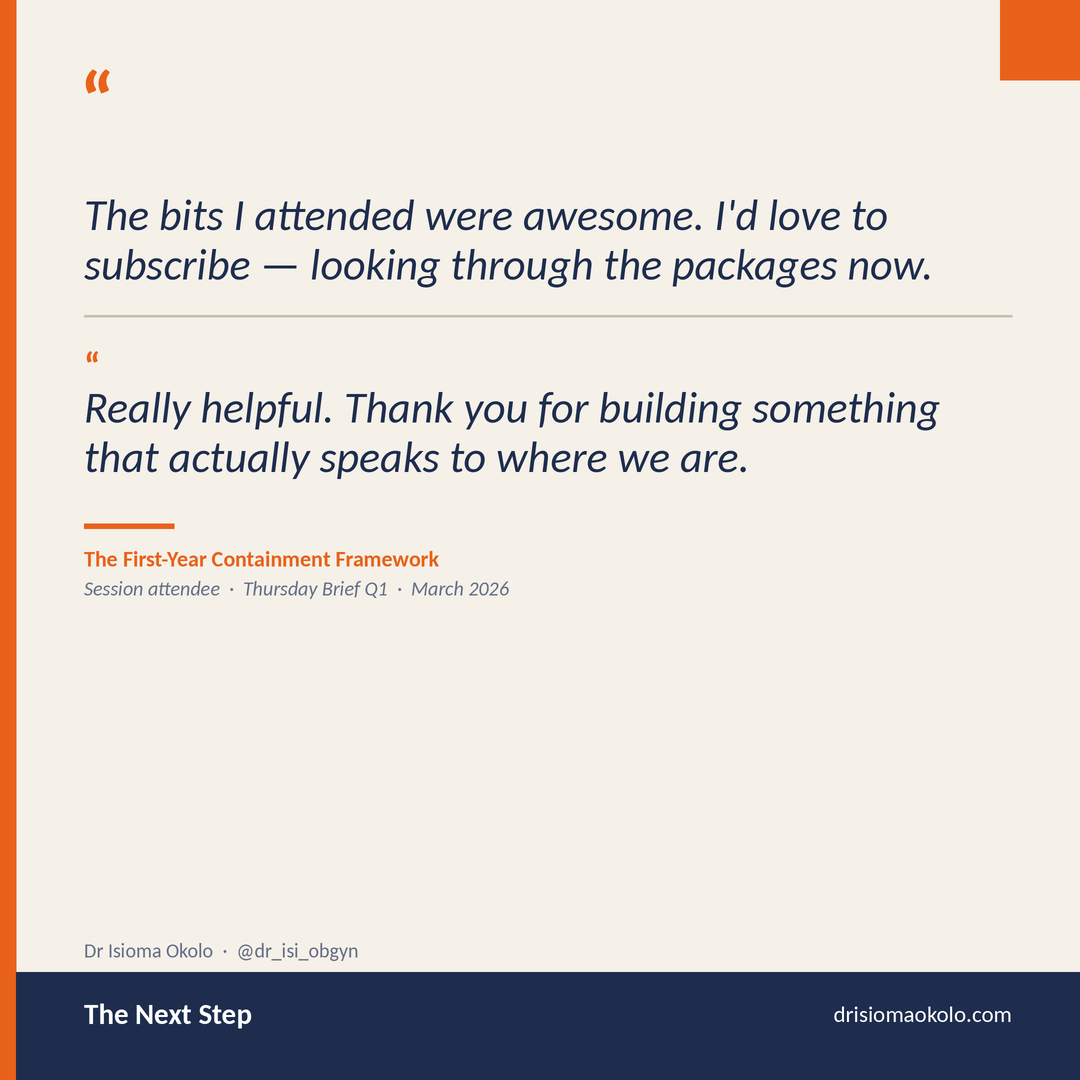
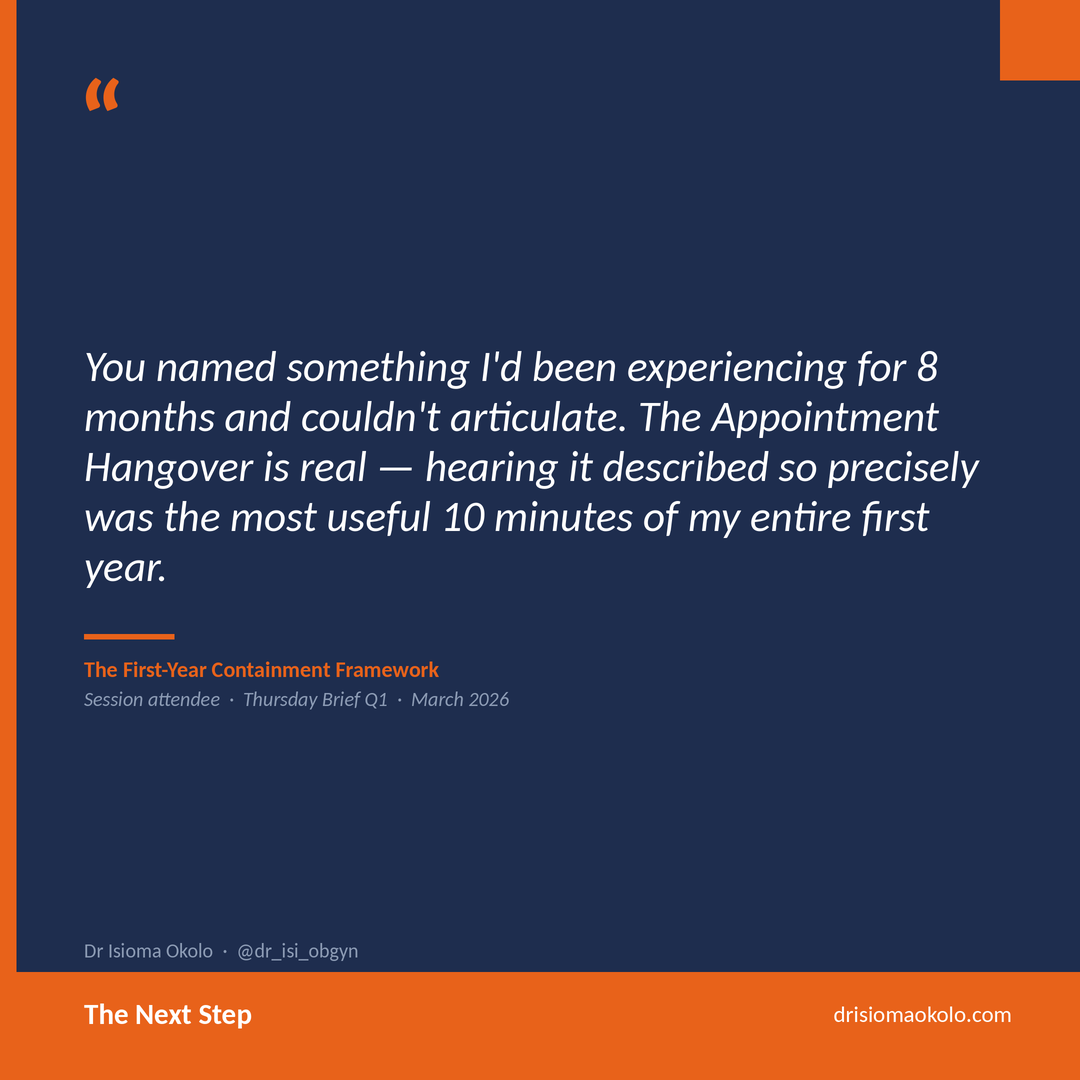
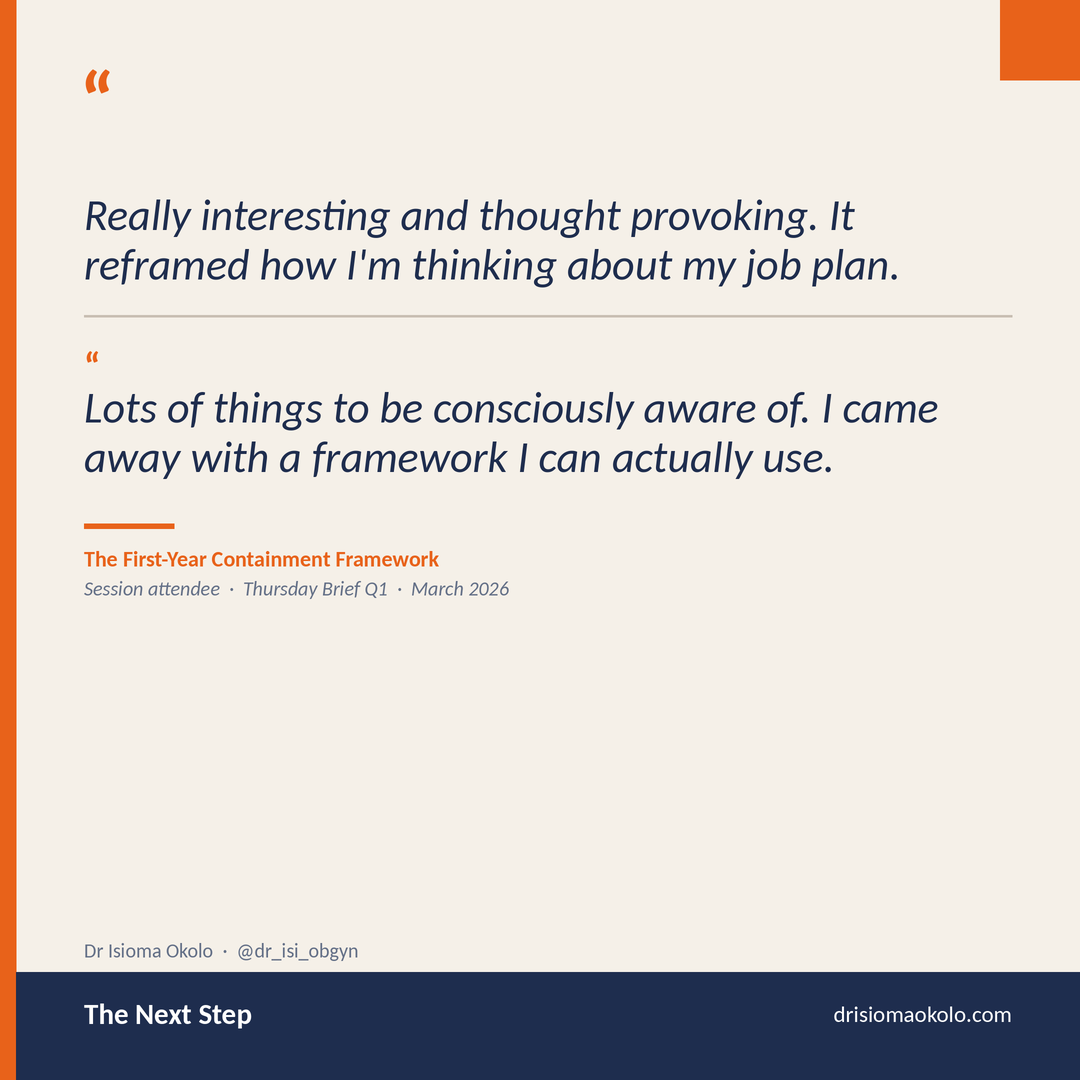
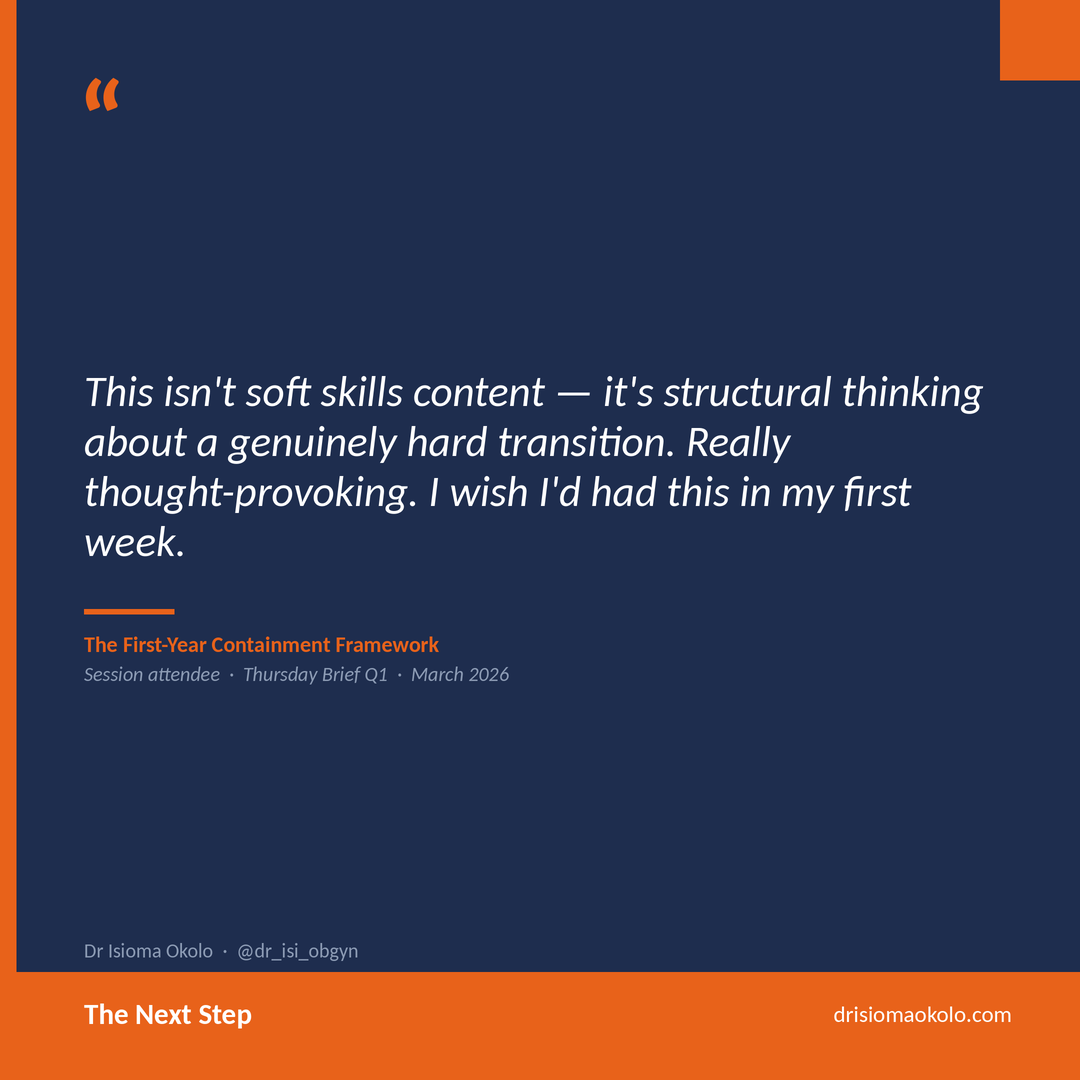
Feedback From The Next Step Participants
MEET YOUR COACH: DR OKOLO

This course exists
because I needed it.
Consultant Obstetrician & Gynaecologist
Harvard-trained Coach & Researcher
Educator · Writer · Strategist
The Next Step was created to make that hidden curriculum visible."
"I spent my first year as a consultant making expensive mistakes. Not clinical ones — structural, relational, and emotional ones. I made them because no one had ever described the terrain I was walking into.
Over the years I kept hearing the same story: brilliant doctors reaching consultancy clinically prepared — but structurally unprepared.
I’m a Consultant Obstetrician and Gynaecologist, Harvard-trained coach & researcher.
I’ve trained and worked across four continents, and spent years understanding not just how medicine works — but how the systems around medicine work: power, hierarchy, identity, credibility, and the unspoken rules that determine who thrives.
As faculty on the RCOG Leadership Programme, member of the RCOG Taskforce on Differential Attainment, faculty lecturer at University of Oxford Global Surgery, Obstetrics & Anaesthesia and NHS Educational supervisor, I've sat inside the institutions that shape medical careers — and seen, up close, where the system fails the people it's supposed to develop.
The Next Step wasn’t built from theory. It grew out of years of conversations with brilliant doctors who were still struggling — underperforming at interviews or blindly navigating systems they were never taught to understand.
I know what it’s like to be competent and not feel confident; to still feel the system wasn’t built around you.
I’ve come through that experience with something worth teaching.
This is not a course about surviving consultancy. It is a course about how to set yourself up to thrive as a new consultant.
Choose Your Path
Inside The Next Step you’ll learn how to:
Think like a consultant
Shift from individual patient focus to systems-level thinkingPrepare for the interview and beyond
Learn successful job-hunting and interview frameworks that help you get and settle into the jobInterpret your job plan strategically
Understand how programmed activities shape your time, influence, and long-term workload.Recognise organisational power dynamics
Identify who holds influence — formally and informally — in your department.Navigate appraisal and early career signalling
Understand how reputation and progression actually develop in the first years.
If you’re approaching consultancy — or newly there — and want guidance that feels honest, thoughtful, and grounded, you’re in the right place.
When you sign up, you’ll get:
📍 A welcome gift to help you on your consultant journey
📍 Access to my dedicated Careers Newsletter
📍 Updates on The Next Step
No pressure. No noise. Just support for the big step you’re about to take.
The Next Step| 2026 Thursday Series Calendar
Quarterly live webinars hosted by Dr Isioma Okolo with guest speakers. Free for The Next Step members; limited tickets available for non-members.
September 24
…
Tickets to be released
December 17
…
Tickets to be released
Catch Up on My Most Popular Career Blogs


The shift from resident to consultant feels like the first trimester of a pregnancy: exhilarating, unsettling, and full of lessons no one warns you about.
In this piece I share what I wish I’d known in those early months — the unexpected realities, boundaries, and rhythms that shape thriving in your new role.